
Our strategy
Planning the territory through PACTE Hubs
PACTE — Produce, Aggregate, Commercialise, Transform, Export — is XP-NOVA's doctrine for moving value from the field to the market. ODT turns it into a territorial planning strategy: one Hub in each production area as a local development pole, then a network of linked poles.
How to read this page
PACTE is XP-NOVA's model for moving value from the field to the market. This page shows how ODT turns it into a territorial planning strategy: one Hub per production area, then a network of Hubs linked to markets.
- The five pillars and the collective facilities each one requires.
- The three scales: hub site, production area, network.
- The municipality's role, its safeguards and an illustrative case in FCFA.
The principle
Money is made at the market and must flow back to the territory
An organised, readable and negotiated value chain replaces a chain that is endured: each actor knows what it brings, what it receives and how its contribution strengthens the whole.
Three laws
- Produce for demand
- Transform for value
- Export for impact
They extend the Produce-Transform-Export doctrine shared by the XP-NOVA divisions.
The five pillars
What each pillar requires from the territory
Each pillar rests on collective facilities: this is where ODT comes in.
Produce
Secure and professionalise the production base: frugal, shared mechanisation, local technical and animal-health support, Agro-Practitioner status.
Facilities delivered by ODT: Rural roads, water management, energy, shared equipment platforms, soil restoration.
Aggregate
Bring scattered producers together into a structured economic force: reformed cooperatives, collection Hubs, secure land tenure.
Facilities delivered by ODT: Collection centres, cooperative houses, land mediation and territorial governance.
Commercialise
Link production to buyers identified in advance, under contract, so that value no longer leaves the territory.
Facilities delivered by ODT: Storage warehouses, logistics hubs, roads and corridors to markets.
Transform
Capture added value as close as possible to the production area: zero-kilometre processing, cold chain, slaughtering depending on the value chain.
Facilities delivered by ODT: Primary processing units, post-harvest stations, agro-industrial platforms, cold chain.
Export
Reach regional and international markets with compliant, traceable products (EUDR, HACCP, ISO 22000).
Facilities delivered by ODT: Traceability from the Hub onwards, post-harvest stations, export corridors.
The PACTE Hub
A facility that anchors the territory
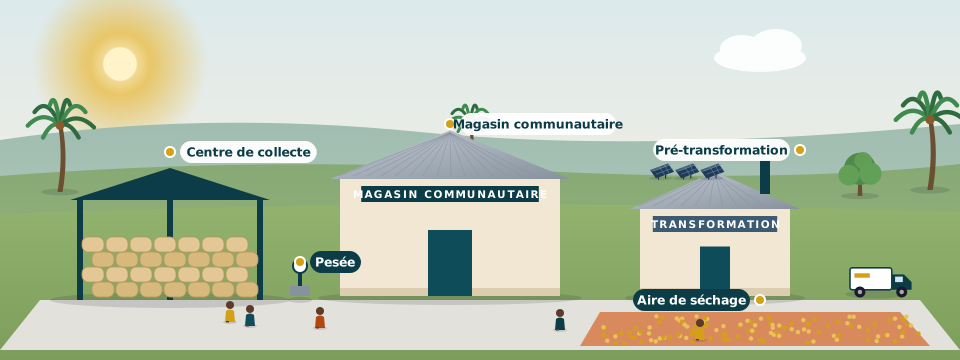
The Hub brings six functions together in one place. Rather than waiting for the territory to be fully equipped, it provides these functions in modular form, directly in the production area.
Aggregate
Collection, weighing, sorting and certification of volumes
ODT-2.3Transform
Drying, storage, primary processing, cold storage or slaughtering depending on the value chain
ODT-4.2Train
Farmer field school attached to the Hub, open to young people from the territory
ODT-2.2Secure
Enclosed site, solar-powered lighting and CCTV, access control
ODT-2.4Trace
Producer identification, plot geolocation, lot history
ODT-1.4Anchor
Solar energy and connectivity for the surrounding area
The planning strategy
Three scales, from pole to network
ODT deploys the Hubs from the most local to the widest scale. This framework does not replace the State's major works: it prepares and guides them, by first creating the activity that justifies public investment.
Establish the Hub
Select the site with the municipality, secure the land, and design the Hub's buildings, energy supply and security.
Serve the producers
Open priority roads, manage water, share mechanisation, delineate transhumance corridors and grazing areas, restore soils.
Connect Hubs to markets
Link several Hubs at inter-municipal or regional level: corridors, logistics hubs, cold chain, inclusion in development plans.
Territorial challenges
What PACTE changes for a territory
| Challenge | Pillar | Response | Domains |
|---|---|---|---|
| Responsibilities transferred to municipalities without sufficient resources | A local operational relay supporting municipal services, under a project management assistance mandate | ||
| Isolation and delayed development | The Hub brings energy and connectivity to its area without waiting for major works; priority roads link it to producers | ||
| Conflicts between farmers and herders | Community mediation, demarcated transhumance corridors and grazing areas | ||
| Land tenure insecurity | Community mediation and clear land contracts (long-term leases, usufruct) | ||
| Post-harvest losses | Storage and processing as close as possible to production areas | ||
| Rural youth out-migration | Jobs at the Hub and training at the farmer field school | ||
| Theft and insecurity in rural areas | Enclosed, guarded Hubs and community-based social engineering |
The municipality in PACTE
A land and administrative contribution
What the municipality brings
- Local roots and help with land access
- Issuance of administrative documents
- Support for community mediation
- Relaying information to residents
- Inclusion of the Hub in the municipal development plan
What it receives
- Structured economic activity in its area
- Local jobs that keep young people in the area
- Additional tax revenue (business licences, local taxes)
- A first step towards development: energy, connectivity, security
- Stronger social cohesion
Safeguards
- The Hub is managed by the cooperative or a partner operator, not by municipal services.
- The municipal council retains all its powers: XP-NOVA exercises no administrative authority.
- In the PACTE model, the Hub is not financed by the municipality: its contribution is land and administrative support.
- Funds raised are held in an OHADA-law escrow account and released after technical sign-off of each stage.
Illustrative case
A maize Hub in a rural municipality
Maize collection and processing Hub serving a cooperative of 150 producers. Average local wage assumed: FCFA 90,000 per month for a direct job, FCFA 60,000 for an indirect job. Tax revenue: 2% of new activity.
| Indicator | Realistic scenario |
|---|---|
| Direct jobs at the Hub (management, weighing, security, maintenance) | 12 |
| Indirect jobs (transport, trade, service providers) | ≈ 25 |
| Direct payroll injected locally | ≈ FCFA 12,960,000/year |
| Indirect income circulating in the territory | ≈ FCFA 18,000,000/year |
| Additional farm income for producers | ≈ FCFA 20,000,000/year |
| Additional local tax revenue | ≈ FCFA 1,800,000/year |
| Scenario | Jobs | Activity/year | Local tax/year |
|---|---|---|---|
| Pessimistic | 25 | ≈ FCFA 55,000,000 | ≈ FCFA 1,100,000 |
| Realistic | 37 | ≈ FCFA 90,000,000 | ≈ FCFA 1,800,000 |
| Optimistic | 50 | ≈ FCFA 130,000,000 | ≈ FCFA 2,600,000 |
One engineering team
Who does what in a PACTE project
ODT
Territorial anchoring: site selection with municipalities, land and mediation, collective facilities, networking of Hubs, public funding.
AGROVITA
The value chain: producers, crop and livestock practices, buyers, contracts, access to export.
Technologie
Equipping the Hub: drying, cold storage, processing, energy, digital traceability.
Formation
The field school: competency frameworks and pathways for Agro-Practitioners and managers.
Let's talk about your territory
Describe your territory and your ambition: a first response within 48 working hours.