
Our vision
The agrosystem as the engine of territorial development
Use the agrosystem as the engine of territorial development, turning local potential into sources of jobs, value and socio-economic resilience.
How to read this page
ODT uses the agrosystem as the engine of territorial development. This page explains the principle, the reference framework shared across XP-NOVA and the division of roles between ODT and the other divisions.
- The principle: from local potential to jobs, in four steps.
- The three strands of the vision: territorial architecture, integrated system, jobs as the result.
- ODT's own missions and the support of the other XP-NOVA divisions.
The principle
From local potential to jobs
A rural territory has land, water, produce and organised communities. ODT activates these resources through the agrosystem, links them with collective facilities and measures what they produce in jobs, value and resilience.
- Starting point
Local potential
- Land and water
- Produce and know-how
- Organised communities
- Lever
An activated agrosystem
- Structured value chains
- Managed resources
- Production, processing, services
- Support
An integrated territory
- Roads, energy, water
- Collective facilities
- Local governance
- Result
Jobs, value, resilience
- Direct, indirect and induced jobs
- Value kept locally
- Resistance to shocks
Our reference framework
What is an agrosystem?
The organised set of natural, human, technical, economic and institutional resources mobilised to produce agricultural goods and services sustainably within a given agro-ecosystem. It is the definition shared by the four XP-NOVA divisions.
The agrosystem as the architecture of the territory
The agrosystem provides the organising framework for the territory.
- Structure value chains
- Make better use of natural resources
- Link production, processing and services
- Locate rural infrastructure where it serves economic activity
The territory as an integrated system
The territory works as an ecosystem in which each part strengthens the others.
- Farming activities feed into other sectors
- Infrastructure supports mobility, energy and water
- Communities take part in local governance
- Each investment generates multiplier effects
Employment as the outcome
An active agrosystem creates work at three levels.
- Direct jobs: production, processing, logistics
- Indirect jobs: services, maintenance, trade
- Induced jobs: innovation, digital services, training
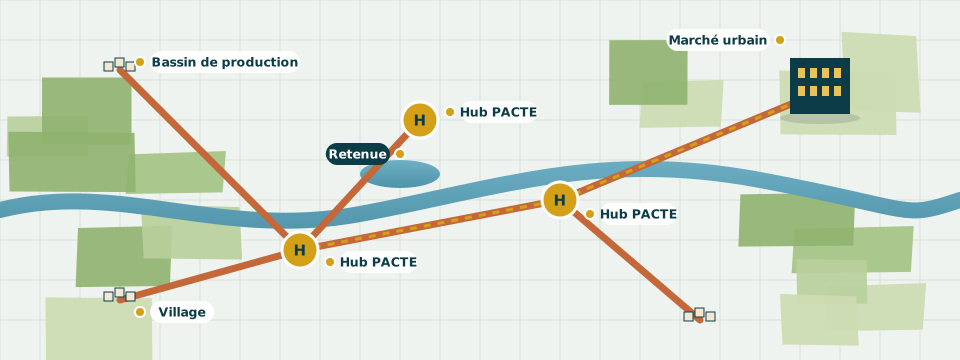
Our strategy: PACTE Hubs
Job pools
Three levels of jobs
Direct jobs are created in the facilities and value chains; indirect jobs among suppliers and service providers; induced jobs from the spending of new income and the activities the territory attracts.
| Domain | Direct jobs | Indirect jobs | Induced jobs |
|---|---|---|---|
| 1. Production | Labour on rural road and land development works (labour-intensive methods) · water distribution agents and irrigation scheme managers · Drivers and operators of shared equipment platforms | Road maintenance workers · Repairers of pumps, farm machinery and solar systems · Input distributors | Local energy services (cold storage, charging, small-scale processing) · Locally trained solar and hydraulic technicians · Rural trade driven by farm incomes |
| 2. Processing & post-harvest | Collection centre staff and storekeepers · Drying, sorting and packaging operators · Primary processing unit workers | Packaging and transport · Equipment maintenance · Inventory-backed financial services (warehouse receipt credit) | Quality control, certification and digital traceability · Trade in processed products · Training in quality-related trades |
| 3. Logistics & transport | Handlers and hub managers · Cold chain operators · Drivers and hauliers | Vehicle mechanics and maintenance · Fuel and energy supply · Catering and services along corridors | Digital freight and consolidation platforms · Specialised logistics services · Signage fabrication workshops |
| 4. Social & organisational | Cooperative managers and accountants · Facilitators and development officers · Training centre staff | Maintenance of shared buildings · Administrative, legal and accounting services · Catering and accommodation during training sessions | Trainers and agricultural advisers · Digital services for farmer organisations · New businesses arising from training |
| 5. Environment & resilience | Nursery workers · Reforestation and erosion-control teams · Wardens for sensitive areas | Production and transport of seedlings and materials · Maintenance of drainage structures · Field monitoring | Non-timber forest products and beekeeping · Environmental monitoring and carbon projects · Ecotourism |
Job numbers are estimated project by project, from the sizing of the facilities, then monitored during operation.
From vision to action
ODT's own missions, and the support it mobilises
ODT keeps the territorial engineering missions that are its own and relies on the other XP-NOVA divisions for the rest, to avoid any overlap.
ODT's own missions
- Assess and plan. Territorial assessment, needs identification, prioritisation and investment programming.
- Site and secure. Site selection, land tenure, environmental and social impact assessments, community consultation.
- Design shared infrastructure. Rural civil engineering: rural roads, embankments, reservoirs, shared buildings, area development.
- Organise governance. Statutes, management committees, user associations, inter-municipal cooperation, operating models.
- Finance. Territorial financing packages: public budgets, donors, PPPs, climate funds.
- Manage and measure. Delegated project ownership, works supervision, monitoring and evaluation, SDG indicators.
What ODT mobilises
Let's talk about your territory
Describe your territory and your ambition: a first response within 48 working hours.