
Challenges
The challenges of territorial development in Cameroon
Six challenges shape life in Cameroon's rural territories. Each calls for collective facilities, governance and funding: ODT's field of action.
How to read this page
Six challenges shape life in Cameroon's rural territories. Each is backed by public, sourced and dated figures and linked to the ODT domains that respond to it.
- Each figure shows its source organisation, date and a link.
- Reference years differ between indicators.
- ODT's response points to the relevant domains and services.
Challenge 1
Decentralisation still incomplete
Municipalities and regions have been given responsibility for water, rural roads, public facilities and the environment. Financial and human resources have not kept pace: many local authorities have neither a technical department nor a portfolio of investment-ready projects.
ODT's response. Programme investments, prepare bankable project files and support municipal project ownership.
Challenge 2
Isolated production areas
Almost the entire network is unpaved, and municipal roads deteriorate quickly. In the rainy season, whole production areas are cut off from markets and inputs.
ODT's response. Prioritise and design rural roads, crossing structures and signage, and plan their maintenance.
Challenge 3
The urban–rural gap in basic services
The gap between urban and rural areas remains very wide for electricity, drinking water and sanitation. Without water and energy there is no irrigation, no cold storage and no local processing.
ODT's response. Plan water and energy at territorial level and organise service management.
Challenge 4
Post-harvest losses that destroy value
A large share of cereals is lost before reaching the market because drying, storage and collection are not organised.
ODT's response. Design collection centres, warehouses and post-harvest stations, and set up their collective management.
Challenge 5
Poverty that is mainly rural
Poverty affects more than one rural resident in two, even though agriculture supports most of the population. Shared infrastructure is one of the few levers that can raise the incomes of many households at once.
ODT's response. Target investments where they reach the largest number of producers.
Challenge 6
Climate vulnerability
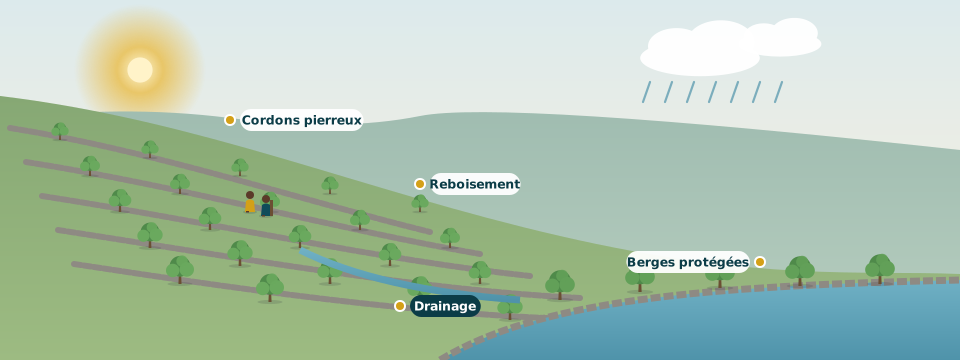
Droughts and extreme events are becoming more severe; the northern regions, coastal areas and highlands are the most exposed. Women, who make up much of the informal agricultural workforce, are on the front line.
ODT's response. Restore soils, manage water, protect sensitive areas and make infrastructure resilient.
Sources
Where these figures come from
All figures are public. They were checked on 21/10/2026 and will be updated with each new release by the organisations cited. Reference years differ between indicators: compare them with care.
- Ministry of Public Works (MINTP), interview with the Minister in Cameroon Tribune — data as at 31/12/2023 — cameroon-tribune.cm ↗
- INS, Fifth Cameroon Household Survey (ECAM5) — published 30/04/2024 — ins-cameroun.cm ↗
- WHO/UNICEF JMP 2025, pS-Eau country profile — 2025 — bdd.pseau.org ↗
- APHLIS, cereal post-harvest losses, Cameroon — 2021 estimates — aphlis.net ↗
- World Bank, Country Climate and Development Report (CCDR) Cameroon — November 2022 — www.worldbank.org ↗
- OECD / UCLG World Observatory on Subnational Government Finance (SNG-WOFI) — 2020 data — www.sng-wofi.org ↗
- Journal du Cameroun — 10/08/2023 — fr.journalducameroun.com ↗
Let's talk about your territory
Describe your territory and your ambition: a first response within 48 working hours.